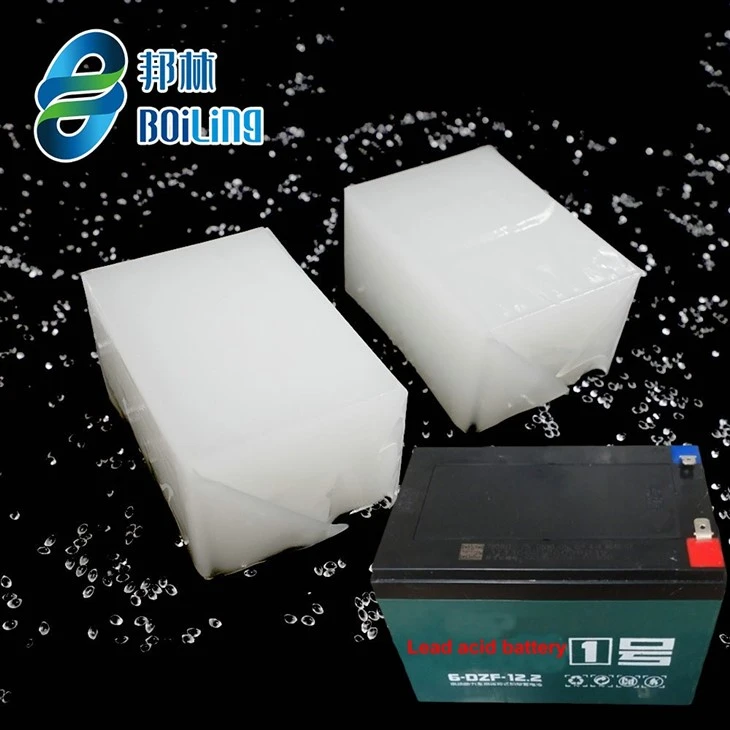
Battery production is an assembly industry with adhesive in it: cases are bonded and sealed, components are fixed, and covers are closed — on lines where the adhesive must behave identically on the ten-thousandth unit as on the first. The manufacturer's hot melt detail listings document lead-acid battery as an application direction of its range (the APAO product imagery itself presents the adhesive blocks alongside a lead-acid battery), and the company's own application summary lists automotive batteries among the industries it serves.
The specification environment is unforgiving in specific ways. The adhesive works around polypropylene cases — a low-energy plastic that resists wetting and is the industry's standard case material — and around the battery's chemical environment, where acid resistance at seals and joints is a working requirement rather than a brochure word. Line behaviour matters as much: battery plants are automated, and stringing, charring or viscosity drift become scrap batteries. A battery adhesive enquiry is therefore a process document — case material, joint design, application equipment, cycle time and the tests the finished battery must pass — before it is a price request.
What Is Confirmed Per Product
This application is documented as a category of the manufacturer's range rather than as one published parameter set, so no single specification table covers it. To have the grade for your job confirmed in the written quotation, send: the substrate and the surfaces being bonded; the application method and coat weight; the working and service temperatures; and the block form and quantity you need. The quoted grade's viscosity, softening behaviour, working temperature, block form and price are confirmed against those inputs, and proven with a sample before bulk.
Specifying Battery Adhesive
- Assembly task — case sealing, cover bonding, component fixing, or another defined joint.
- Case and joint materials — polypropylene or other case materials, and the joint design and gap.
- Process — application equipment, temperature, cycle time and any curing or pressing.
- Test regime — leak, vibration, temperature and chemical exposure tests the battery must pass.
Evaluation should run on production cases through the plant's own battery tests, including leak and temperature cycling, because a battery joint cannot be qualified on a peel coupon alone. The documented association is visible in the manufacturer's own APAO listing, which photographs adhesive blocks beside a lead-acid battery.
How to Specify This Adhesive
A useful enquiry names five things: the substrate or material being bonded, the application method and equipment, the coat weight in grams per square metre where it is known, the temperature the bond must withstand in service, and the test standard your customer applies. Those five points are the same starting points the manufacturer's own customisation process uses when it opens a new formulation brief, and they let the laboratory match an existing grade before anyone talks about developing a new one.
If you are replacing an adhesive already in production, send its current grade name or a sample description — viscosity behaviour, colour and the failure you are trying to fix narrow the choice faster than a catalogue number. Samples are part of the documented route: free samples are listed on many product pages, and the freight arrangement for your sample is confirmed in the reply.
Supply, Packing and Samples
The documented minimum order on product listings is 1,000 kg, consistent with the 1-tonne minimum stated in the manufacturer's published frequently asked questions, and the documented production cycle is 7–15 days. Packing follows the listing for the grade — film-wrapped blocks are the standard form, with carton packing stated per product — and can be confirmed against your handling requirements in the quotation. Nothing on this page promises a grade's availability before the quotation confirms it for your specification.
Which battery types are covered?
Lead-acid battery assembly is the documented direction in the manufacturer's listings. Other battery chemistries and constructions should be raised in the enquiry for an honest placement.
Does it bond polypropylene cases?
PP is the standard case material of this industry and the central wetting challenge of the application. Case material is a required enquiry point and a sample-test item.
What parameters apply?
Parameters are confirmed per product for your joint and process: the direction is organised by application rather than by one shared table, so the figures for your joint are set in the quotation.
Send the application, substrate, application method and the quantity you need — the grade, sample route and price are confirmed per product in the written quotation.
Request a Quotation