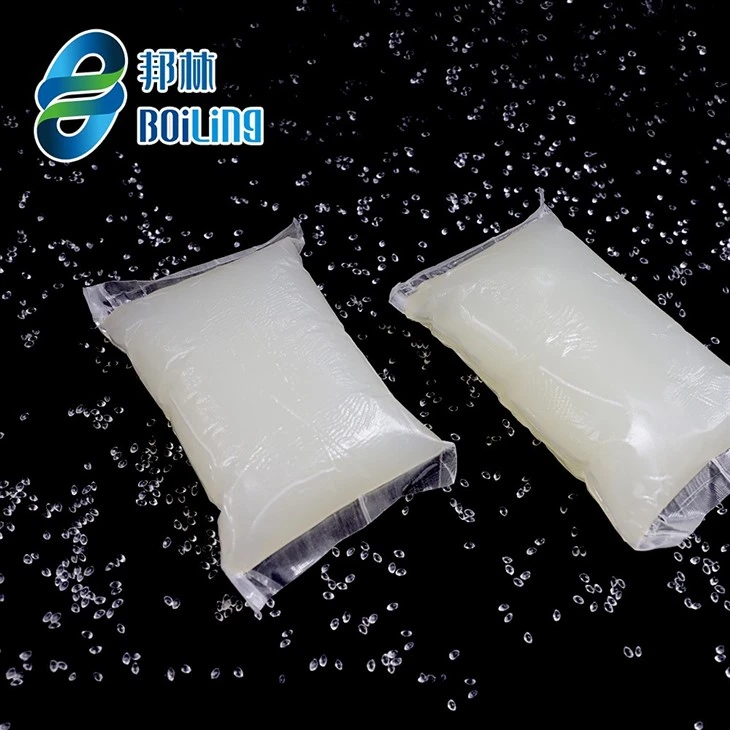
Three of the label types the manufacturer documents are covered in depth here: thermal paper labels, logistics labels and barcode labels. All three are coated the same way — hot melt PSA applied to face stock, laminated to a release liner, die-cut and rewound — but they stress the adhesive differently, and the documented listings treat them as distinct products rather than one grade with three names.
Thermal paper labels carry a heat-sensitive coating that darkens with the print head; the adhesive must coat without disturbing that layer and hold through warehousing. Logistics labels live a short, hard life: applied to cartons, exposed to cold vehicles and rough handling, and expected to stay readable and attached until delivery — the documented logistics listing is positioned as a strong-tack grade. Barcode labels are the precision case: the documented barcode listing is a transparent grade whose stated characteristics are no oil seepage, no glue overflow and easy die-cutting ('easy to straddle cut' in the listing's words), because a barcode label that oozes at the edge collects dust and fails scans.
| Documented label adhesive listings | Value |
|---|---|
| Viscosity (at 180°C) | 1,500–3,500 cps on the documented label listings |
| Softening point | 70–100°C on the documented label listings |
| Working temperature | 150–180°C on the documented label listings |
| Block specification | 0.45 / 0.6 / 1 / 5 kg per block |
| Minimum order | 1,000 kg on the documented label listings |
Matching the Grade to the Label
Start from the face stock and the service, not from the adhesive shelf. Paper faces forgive more than film faces; a label that will be frozen needs the freezer direction of the family rather than a general grade; a label on a small bottle needs the flexibility discussed on the bottle labelling page. Coat weight matters as much as grade choice: the manufacturer's customisation brief itself asks for the gluing amount in grams per square metre, because tack, ooze and cost all move with coat weight. A coating trial at your line speed, on your face stock and liner, is the documented route before bulk — samples are listed as freely available on these product pages, with the sample freight arrangement confirmed in the reply.
Two failure patterns deserve naming because buyers often meet them first. Edge lifting within days usually means the adhesive's flexibility or tack is wrong for the container diameter or the face stock's stiffness. Adhesive bleeding in stored rolls usually means the coat weight or the grade's flow behaviour is wrong for the storage temperature. Both are specification problems with specification answers; bring the details to the enquiry rather than a request for 'stronger glue'.
How to Specify This Adhesive
A useful enquiry names five things: the substrate or material being bonded, the application method and equipment, the coat weight in grams per square metre where it is known, the temperature the bond must withstand in service, and the test standard your customer applies. Those five points are the same starting points the manufacturer's own customisation process uses when it opens a new formulation brief, and they let the laboratory match an existing grade before anyone talks about developing a new one.
If you are replacing an adhesive already in production, send its current grade name or a sample description — viscosity behaviour, colour and the failure you are trying to fix (edge lifting, ooze, stringing, cold failure) narrow the choice faster than a catalogue number. Samples are part of the documented route: free samples are listed on many product pages, and the freight arrangement for your sample is confirmed in the reply.
Supply, Packing and Samples
The documented minimum order on product listings is 1,000 kg, consistent with the 1-tonne minimum stated in the manufacturer's published frequently asked questions, and the documented production cycle is 7–15 days. Packing follows the listing for the grade — film-wrapped blocks are the standard form, with carton packing stated per product — and can be confirmed against your handling requirements in the quotation. Nothing on this page promises a grade's availability before the quotation confirms it for your specification.
Can one grade run thermal and logistics labels?
They are documented as distinct listings because their stresses differ. A plant running both should expect two grades, or a trial proving one grade on both face stocks before committing.
What does 'no oil seepage' mean on the barcode listing?
It is the documented characteristic of the barcode label grade: the adhesive is formulated not to migrate oil into the face stock over storage, which protects print quality and scan reliability.
How is a coating trial arranged?
Send the face stock, liner, line speed and target coat weight. The documented route is a sample first, then performance confirmation, then bulk — the same sequence the manufacturer publishes for custom work.
Send the application, substrate, application method and the quantity you need — the grade, sample route and price are confirmed per product in the written quotation.
Request a Quotation