A freezer label lives two lives. It may be applied to packaging at room temperature and then frozen, or applied directly to already-frozen goods in a cold store — and the two lives stress the adhesive differently. What they share is the service condition: deep cold, frost, condensation when the pack moves between temperatures, and a label that must stay attached and legible through the cold chain. The manufacturer's label family documents a dedicated direction for this case, whose stated characteristic is adhesion maintained at temperatures of −10°C and below.
That single documented characteristic deserves precise reading: the claim is that the freezer grade keeps its adhesive behaviour at −10°C and below, where general label grades harden and release. It is not a promise about application to frosted surfaces at any temperature, nor about every face stock — film and paper faces behave differently in cold, and a label applied to a dry pack before freezing is a different test from one applied onto frost. The sample trial for this category should reproduce the buyer's real sequence: their pack, their application moment, their freezer, their duration.
What Is Documented for This Direction
The manufacturer's freezer label page documents this direction by behaviour rather than by a parameter table: a strong-tack grade whose stated characteristic is adhesion maintained at −10°C and below. No viscosity, softening point or block table is published for this listing. For the quotation and the sample trial, send your face stock, the application moment (before or after freezing) and your cold-chain sequence: the freezer grade's distinguishing behaviour, low-temperature tack, is confirmed against exactly those inputs.
Freezer Label Checks That Matter
- Application moment — before freezing on dry packaging, or onto frozen goods? State which; they are different specifications.
- Frost and condensation — whether the label meets frost at application or condensation on removal from the cold.
- Face stock — paper labels can weaken when wet; film faces suit wet cold. Decide the face and adhesive together.
- Duration — weeks of retail freezer or months of cold storage set different ageing demands.
How to Specify This Adhesive
A useful enquiry names five things: the substrate or material being bonded, the application method and equipment, the coat weight in grams per square metre where it is known, the temperature the bond must withstand in service, and the test standard your customer applies. Those five points are the same starting points the manufacturer's own customisation process uses when it opens a new formulation brief, and they let the laboratory match an existing grade before anyone talks about developing a new one.
If you are replacing an adhesive already in production, send its current grade name or a sample description — viscosity behaviour, colour and the failure you are trying to fix narrow the choice faster than a catalogue number. Samples are part of the documented route: free samples are listed on many product pages, and the freight arrangement for your sample is confirmed in the reply.
Supply, Packing and Samples
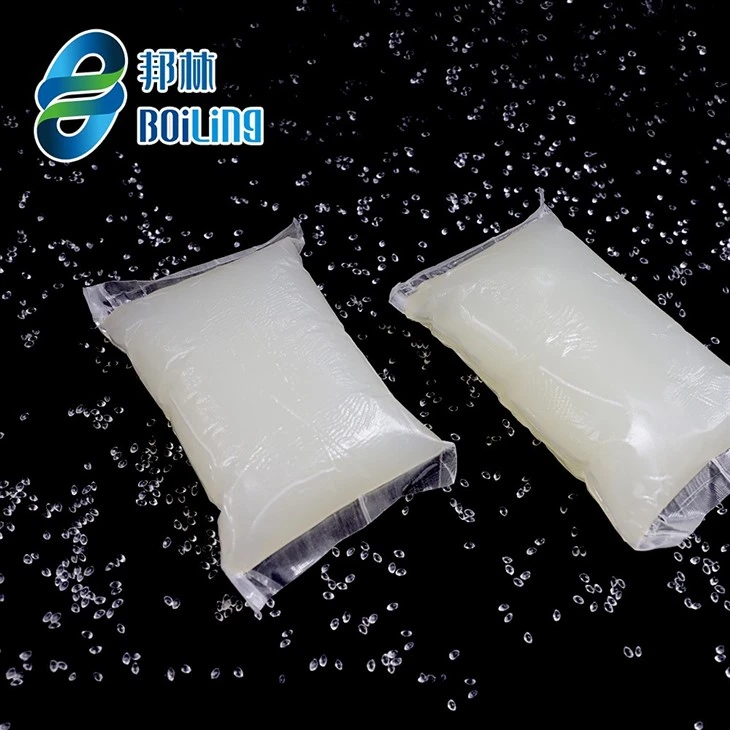
The documented minimum order on product listings is 1,000 kg, consistent with the 1-tonne minimum stated in the manufacturer's published frequently asked questions, and the documented production cycle is 7–15 days. Packing follows the listing for the grade — film-wrapped blocks are the standard form, with carton packing stated per product — and can be confirmed against your handling requirements in the quotation. Nothing on this page promises a grade's availability before the quotation confirms it for your specification.
To what temperature is the freezer grade documented?
The manufacturer's freezer label page states adhesion maintained at −10°C and below. Deeper or longer cold exposure should be sample-tested under your conditions.
Can labels be applied to already-frozen packs?
That is the harder specification and depends on frost at the surface. Describe the application moment in the enquiry and test exactly that sequence with samples.
Freezer labels for food packaging — what documentation?
Ask for the documents your food-packaging file requires; certificates are available upon request, and grade confirmation comes with the quotation.
Send the application, substrate, application method and the quantity you need — the grade, sample route and price are confirmed per product in the written quotation.
Request a Quotation