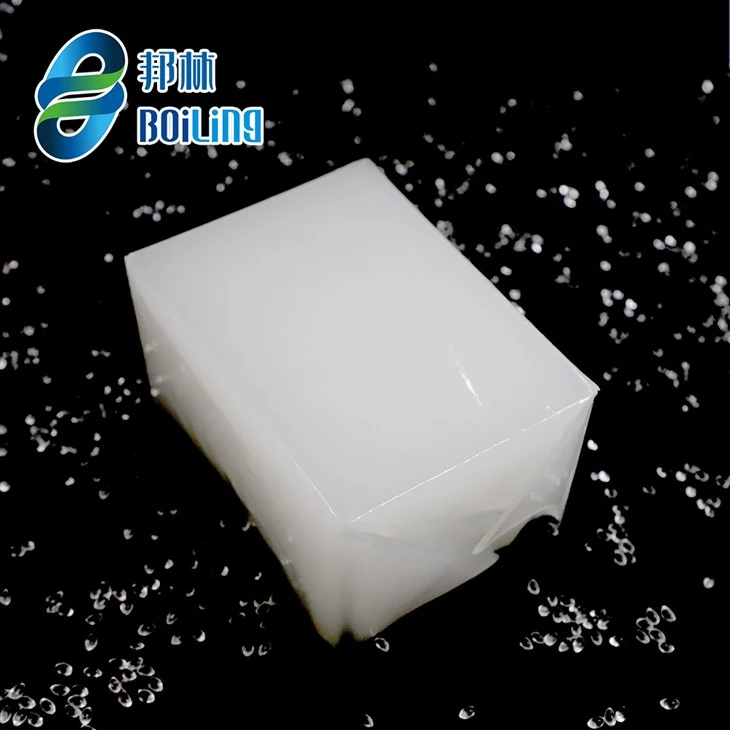
Polyolefin hot melts — built on polyethylene, polypropylene and APAO (amorphous poly-alpha-olefin) bases — are chosen where EVA reaches its limits: better heat resistance, better adhesion to polyolefin plastics themselves, and longer open times for assembly work. In this catalogue the polyolefin family is a named product line with documented sub-lines: an APAO adhesive with a published parameter set, bottle cap glue, automotive hot glue and mattress glue.
Documented APAO Specification
| APAO hot melt adhesive (documented listing) | Value |
|---|---|
| Viscosity (at 180°C) | 1,500–4,000 cps, varying with the substrate |
| Colour | Water white |
| Softening point | 80–100°C, varying with the substrate |
| Working temperature | 150–180°C |
| Block specification | 0.45 / 0.6 / 1 kg per block |
| Samples | Free sample, freight collect, per the listing |
The listing's own note matters: it states that both the viscosity and the softening point vary with the substrate, which is the honest shape of APAO specification — the grade is tuned to what it must wet and hold. APAO's long open time and flexibility make it the assembly adhesive of the family, used where parts are positioned by hand or where the bond line must stay flexible in service.
Sub-Lines in This Family
How to Specify This Adhesive
A useful enquiry names five things: the substrate or material being bonded, the application method and equipment, the coat weight in grams per square metre where it is known, the temperature the bond must withstand in service, and the test standard your customer applies. Those five points are the same starting points the manufacturer's own customisation process uses when it opens a new formulation brief, and they let the laboratory match an existing grade before anyone talks about developing a new one.
If you are replacing an adhesive already in production, send its current grade name or a sample description — viscosity behaviour, colour and the failure you are trying to fix (edge lifting, ooze, stringing, cold failure) narrow the choice faster than a catalogue number. Samples are part of the documented route: free samples are listed on many product pages, and the freight arrangement for your sample is confirmed in the reply.
Supply, Packing and Samples
The documented minimum order on product listings is 1,000 kg, consistent with the 1-tonne minimum stated in the manufacturer's published frequently asked questions, and the documented production cycle is 7–15 days. Packing follows the listing for the grade — film-wrapped blocks are the standard form, with carton packing stated per product — and can be confirmed against your handling requirements in the quotation. Nothing on this page promises a grade's availability before the quotation confirms it for your specification.
What is APAO's advantage over standard polyolefin?
Within this catalogue, APAO is the documented grade for long open time and flexible bonds, with its viscosity tuned per substrate. The general polyolefin discussion starts from your application; the APAO listing is quoted where its behaviour fits.
Does polyolefin replace EVA everywhere?
No. EVA remains the economical answer for paper, board and bookbinding. Polyolefin earns its place on heat, plastics and open-time grounds — the enquiry will place the job honestly.
What block sizes does APAO come in?
The documented APAO listing states 0.45, 0.6 and 1 kg film-wrapped blocks.
Send the application, substrate, application method and the quantity you need — the grade, sample route and price are confirmed per product in the written quotation.
Request a Quotation